
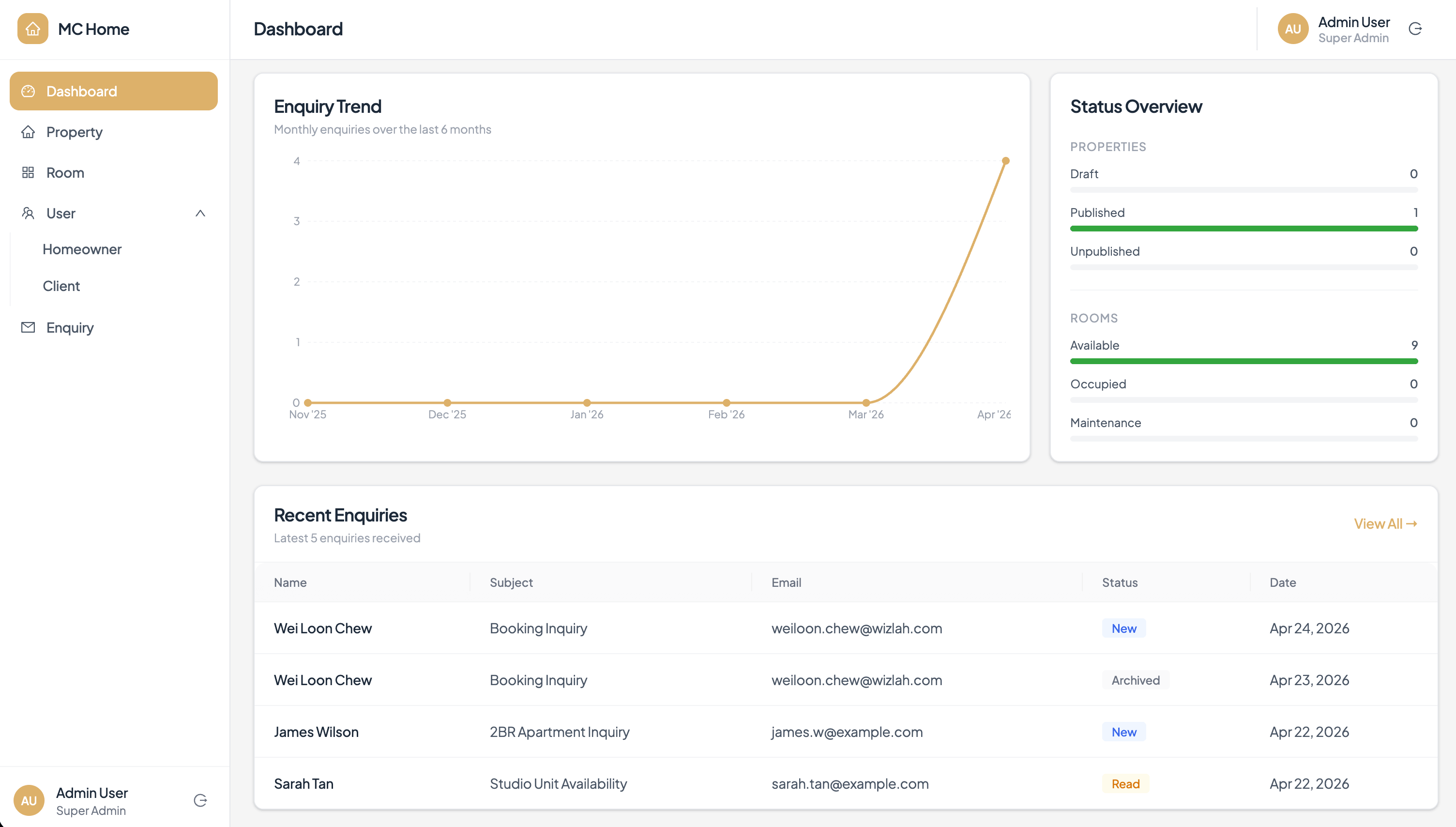
MC Home Admin Portal
Overview
An internal admin dashboard for MC Home Management. It is where the team manages properties, rooms, homeowners, enquiries, and images, all the operational data behind the public MC Home website.
The Problem
The business was managing everything manually and it had gotten fragmented, so they needed one centralized system instead. Property and room information needed to be structured and connected through a clean admin workflow, one that could also handle image uploads, cover image selection, drag-and-drop ordering, filters, and relational data updates.
The Solution
I designed and built a modular admin portal using Next.js Pages Router, Ant Design, MongoDB, and AWS S3, organized into feature-based modules for Property, Room, Homeowner, and Enquiry management. Underneath that sit reusable service layers, protected API routes, structured data models, and drag-and-drop image management built with dnd-kit.
Impact & Results
Centralized System
Operational Efficiency
Was: Manual / Fragmented · Streamlined admin workflowRelational
Data Management
Was: Unstructured · Property ↔ Room ↔ Homeowner linkageDynamic
Content Management
Was: Static · Real-time updates to public websiteAI-Assisted
Development Workflow
Was: Traditional · Faster iteration & improved productivity